
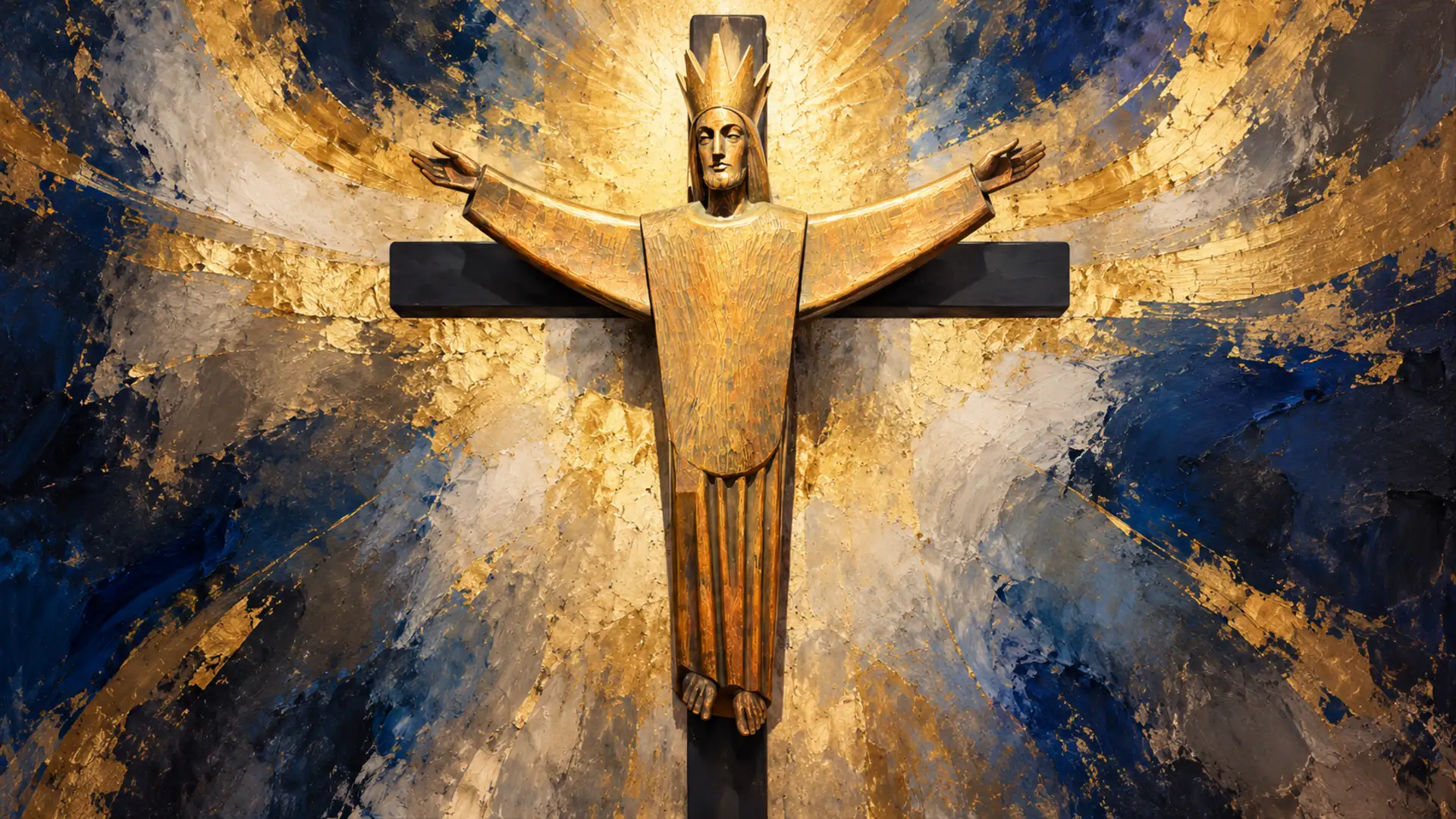
Christ the King: Mercy From the Cross
By Crom Salvatera | Sunday Reading
Christ the King reveals His kingship through the self-giving love and mercy of the Cross. Luke’s Gospel places the promise of paradise within a scene of humiliation, challenging familiar pictures of power.
This reflection accompanies the Solemnity of Christ the King, Year C. It is for readers considering what it means to belong to Christ when success, control and recognition so often shape daily expectations.
Christ the King 2026: Sunday 22 November
Quick Answer: What Does Christ the King Mean?
Christ’s kingship concerns the saving reign of truth, love and mercy. In Luke 23, Jesus receives the appeal of the repentant criminal while suffering on the Cross. The feast invites a personal response of trust. Begin by asking where Christ’s teaching should shape one decision you are making.
Bring that intention into the parish’s Mass and Reconciliation life.
What Kind of King Is Revealed at Calvary?
At Calvary, Christ’s authority is revealed through faithful love under suffering. His promise to the criminal who turns towards Him directs hope beyond the visible defeat of crucifixion [1].
The scene challenges an idea of religion as protection from every loss. Following Christ does not guarantee prestige, comfort or control. It calls us to a faithfulness whose meaning can remain hidden in the moment.
This has consequences for Christian leadership. Authority exercised in Christ’s name should serve the good of others and remain answerable to truth. The Cross cannot be used as decoration for cruelty or personal domination.
Why Does the Criminal’s Prayer Matter?
The criminal’s appeal shows a person turning towards Jesus without possessing a history he can undo. The moment gives hope for repentance while refusing to make wrongdoing trivial.
St Paul describes reconciliation through Christ’s saving work [2]. Christian hope rests there, rather than in an attempt to make ourselves our own saviours.
The passage should not become a reason to postpone conversion. An opportunity for mercy is a gift to receive now. If a wrong can be repaired, repair it. If forgiveness is needed, seek it. If faith has been delayed, take the next honest step.
A Parish Reflection: Allow Christ to Govern One Choice
A feast can remain distant until it touches a decision. Ask what allegiance to Christ means in a disagreement, the use of money or the treatment of someone with less power.
Jesus teaches His disciples to understand greatness through service [3]. The question for a parish is therefore concrete: do our habits make it easier for vulnerable people to approach Christ?
If you would like to return to sacramental life, our Mass and Reconciliation page provides a starting point. The criminal’s prayer reminds us that a truthful appeal can begin with very few words.
Who Is This Reflection For?
People exploring Christian authority and mercy
This article is for parishioners and seekers who want to understand the feast through the Gospel scene at Calvary.
When the language of kingship has been misused
Christ’s kingship must not justify abuse or the demand for unquestioning obedience to a human leader. Safety, conscience and accountability remain essential.
Respond to the Feast
- Name one decision where control has become your chief concern.
- Read the Gospel scene slowly.
- Ask what truth and service require.
- Take one act of repentance, mercy or responsible leadership.
Power Examined in Christ’s Light
| Question | The Gospel’s challenge |
|---|---|
| How is authority used? | For truthful service rather than self-importance. |
| What happens after wrongdoing? | Repentance, mercy and appropriate repair. |
| Where does hope rest? | In Christ’s saving love. |
Frequently Asked Questions About Christ the King
Is this feast a political programme?
The feast proclaims Christ’s sovereignty and calls every area of life towards truth and justice. It should not be reduced to endorsement of a party or human ruler. Christian political responsibility still requires informed moral judgement.
Does mercy remove responsibility?
Mercy opens the possibility of forgiveness and conversion. It does not make harmful actions good or remove every consequence. A person who receives mercy may still need to repair harm and accept appropriate accountability.
Can someone turn to Christ late in life?
Yes. The Gospel gives reason to hope in the possibility of repentance. That hope encourages a response now, rather than planning to defer conversion until an imagined final opportunity.
How can families mark the feast?
Read the Gospel together and pray briefly for a home shaped by truth and service. Choose a practical act of care. Keep the conversation suited to children’s ages without turning the Cross into frightening or coercive language.
What To Do Next
Christ the King invites trust in the mercy revealed at Calvary. Let that trust shape one real decision today.
Contact St Anthony’s Parish to ask about returning to faith or Confession, and explore our Mass information.
About the Author
Crom Salvatera writes about Catholic faith for St Anthony’s Parish, Marsfield, a Catholic community with a Vincentian heritage. This reflection draws on Scripture, the Catechism of the Catholic Church and official Church teaching. Readers seeking personal pastoral guidance are invited to contact the parish.
Continue Reading
- Explore the parish article collection
- The meaning of Good Friday
- The Beatitudes
- Lateran Basilica: Why Catholics Celebrate Its Dedication
- First Sunday of Advent: Learning to Stay Awake


